Software development is a complex process that requires careful planning, technical expertise, and structured execution. Businesses across Singapore increasingly rely on custom software systems to automate operations, deliver digital services, and scale their organisations.
However, many business leaders are unfamiliar with how software development actually works. Without understanding the development process, companies may struggle to plan budgets, manage timelines, or evaluate potential vendors.
A well-structured software development process ensures that digital products are built efficiently while meeting both technical requirements and business objectives.
In this guide, we explain the key stages involved in the software development lifecycle and how businesses can successfully plan and manage software projects.
If you are currently evaluating vendors for your project, you may also want to review our comparison guide on the best software development company in Singapore, which highlights trusted development providers.
Partner with OTG Lab, your trusted software development company in Singapore.
What Is the Software Development Process?
The software development process refers to the structured methodology used to design, build, test, and deploy software systems.
This process ensures that software projects follow clear steps from initial concept to final deployment.
The most common framework used today is the Software Development Lifecycle (SDLC), which divides software development into several stages.
These stages help development teams maintain quality, manage complexity, and deliver reliable software systems.
Why the Software Development Process Matters
Following a structured development process offers several advantages.
Improved project planning
Clear development stages help teams estimate timelines and budgets more accurately.
Higher software quality
Structured testing and review processes reduce bugs and performance issues.
Better collaboration
Defined workflows allow developers, designers, and business stakeholders to work together effectively.
Scalability and maintainability
Well-designed systems are easier to maintain and upgrade over time.
Businesses investing in custom platforms benefit significantly from working with development teams that follow proven methodologies.
Partner with OTG Lab, your trusted software development company in Singapore.
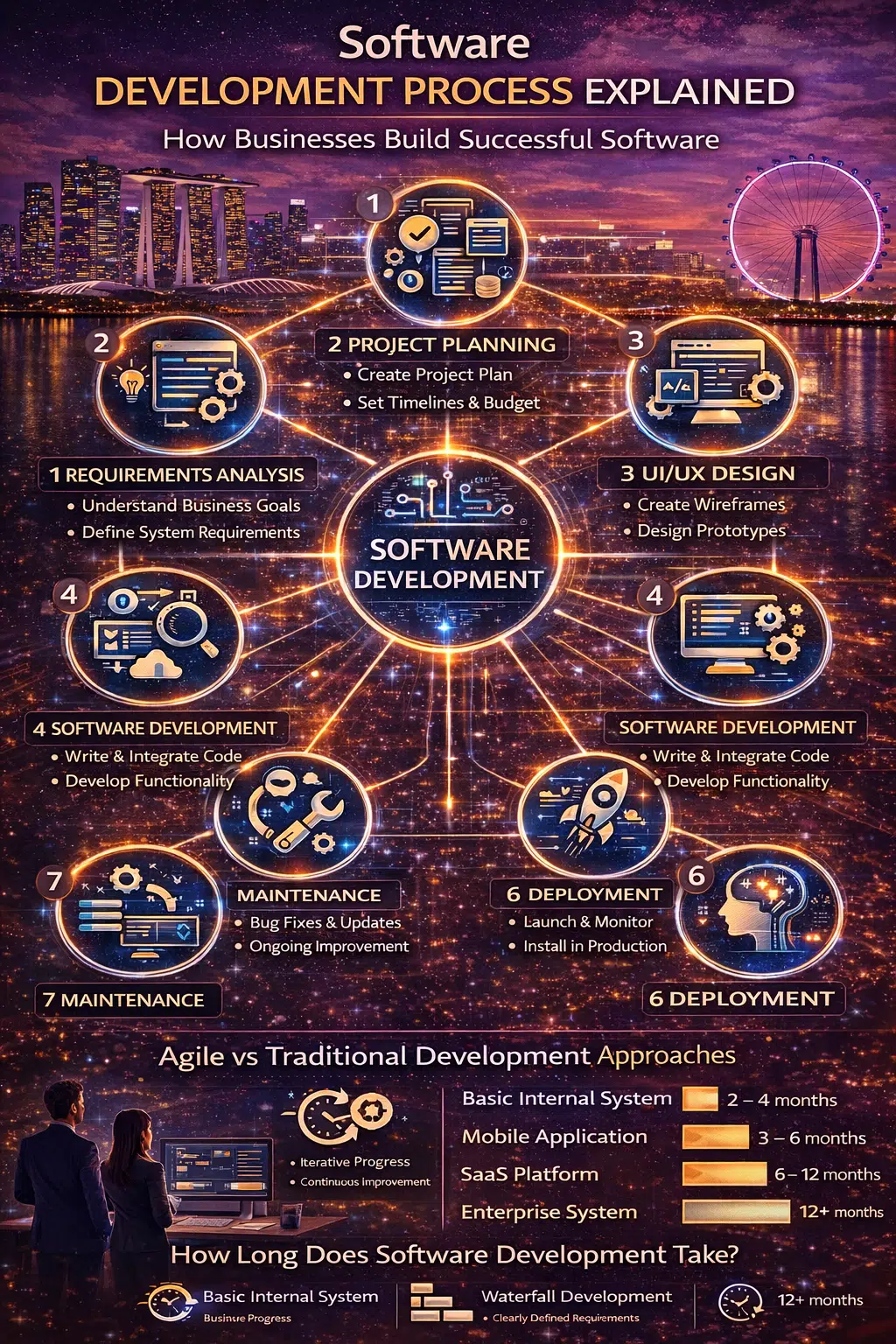
The 7 Stages of the Software Development Process
Although development frameworks may vary slightly between companies, most software projects follow a similar lifecycle.
Below are the key stages typically involved in software development.
1. Requirements Analysis
The first stage of the development process involves understanding the business problem and defining system requirements.
During this stage, development teams work closely with stakeholders to identify:
- business objectives
- user requirements
- system functionality
- integration needs
- technical constraints
This stage is critical because poorly defined requirements can lead to costly changes later in the project.
Many companies begin by creating a product requirements document (PRD) that outlines system specifications.
Partner with OTG Lab, your trusted software development company in Singapore.
2. Planning and Project Scope
Once requirements are defined, the development team creates a detailed project plan.
This stage includes:
- defining development milestones
- estimating project timelines
- determining development resources
- selecting technologies and frameworks
Proper planning ensures that the project remains aligned with business goals.
It also helps companies estimate the software development cost in Singapore before committing to the project.
Partner with OTG Lab, your trusted software development company in Singapore.
3. UI/UX Design
User experience plays a major role in the success of any digital platform.
During the design phase, designers create:
- user journeys
- interface wireframes
- design prototypes
- system architecture diagrams
These visual representations help stakeholders understand how the software will function before development begins.
A well-designed interface improves usability and increases user adoption.
Partner with OTG Lab, your trusted software development company in Singapore.
4. Software Development
Once designs are approved, developers begin writing the actual code for the system.
This stage involves:
- frontend development
- backend system development
- database architecture
- API integrations
Many modern development teams follow Agile development methodologies, which involve building software in small, iterative releases.
Agile development allows teams to adapt quickly to changing requirements.
Partner with OTG Lab, your trusted software development company in Singapore.
5. Testing and Quality Assurance
Before launching a software system, it must undergo rigorous testing to ensure reliability and performance.
Quality assurance teams perform various tests including:
- functional testing
- security testing
- performance testing
- user acceptance testing
Testing helps identify bugs and ensure that the system functions correctly across different environments.
Partner with OTG Lab, your trusted software development company in Singapore.
6. Deployment
Once testing is completed, the software is deployed to a production environment.
Deployment may involve:
- cloud infrastructure configuration
- database setup
- server deployment
- system integration
At this stage, the software becomes available to end users.
Cloud platforms have simplified deployment processes by allowing applications to be launched quickly and scaled automatically.
Partner with OTG Lab, your trusted software development company in Singapore.
7. Maintenance and Continuous Improvement
Software development does not end after deployment.
Most systems require ongoing maintenance, including:
- bug fixes
- security updates
- feature enhancements
- performance optimisation
Businesses often continue improving their platforms based on user feedback and changing operational requirements.
This stage ensures that the system remains effective and secure over time.
Partner with OTG Lab, your trusted software development company in Singapore.
Agile vs Traditional Development Approaches
Different development methodologies can be used to manage software projects.
Two of the most common approaches are Agile development and Waterfall development.
Agile Development
Agile development focuses on iterative progress and continuous improvement.
Features are delivered in small increments, allowing businesses to test and refine the product quickly.
Waterfall Development
Waterfall development follows a more linear approach where each stage must be completed before the next begins.
Although less flexible, it can be useful for projects with clearly defined requirements.
Most modern software companies prefer Agile methodologies because they provide greater flexibility.
Partner with OTG Lab, your trusted software development company in Singapore.
How Long Does Software Development Take?
Development timelines depend on project complexity and feature requirements.
Typical timelines include:
| Software Type |
Development Time |
| Basic internal system |
2 – 4 months |
| Mobile application |
3 – 6 months |
| SaaS platform |
6 – 12 months |
| Enterprise system |
12+ months |
Businesses should work with experienced development partners to ensure realistic project timelines.
Partner with OTG Lab, your trusted software development company in Singapore.
Choosing the Right Development Partner
Even the best development process cannot guarantee success without the right development team.
When evaluating vendors, businesses should consider:
- technical expertise
- portfolio and case studies
- communication and project management
- long-term support services
You can learn more in our guide on how to choose a software development company in Singapore.
Partner with OTG Lab, your trusted software development company in Singapore.
Why Businesses in Singapore Choose OTG Lab
OTG Lab works with businesses across Singapore to design and develop scalable digital platforms.
Key strengths include:
Strategic consultation
Every project begins with detailed discovery sessions.
Structured development process
Projects follow proven methodologies to ensure reliability and scalability.
End-to-end development services
From planning and design to development and deployment.
Scalable architecture
Systems are built to support long-term business growth.
This structured approach ensures businesses receive software solutions tailored to real operational requirements.
Partner with OTG Lab, your trusted software development company in Singapore.
Final Thoughts
Understanding the software development process helps businesses plan successful digital projects.
By following structured development stages – from requirements analysis to deployment and maintenance – organisations can build reliable and scalable software systems.
Companies planning custom software projects should work with experienced development partners who follow proven methodologies.
If you are evaluating vendors, our guide on the best software development company in Singapore highlights trusted development providers. We also provided guides on software development services in Singapore and what is custom software development.
Partner with OTG Lab, your trusted software development company in Singapore.
Start Your Software Development Project
If your organisation is planning to develop a digital platform, partnering with an experienced development team can significantly improve project outcomes.
At OTG Lab, we specialise in designing and building scalable digital solutions tailored to modern business needs.
From planning and architecture design to development and deployment, our team helps companies successfully implement digital platforms.
Contact our experts today to explore how custom software can support your business growth.