The Internet of Things (IoT) is transforming how businesses operate by connecting physical devices to digital systems. From smart factories and logistics networks to retail stores and buildings, IoT enables organisations to collect real-time data, automate processes, and improve decision-making.
While many businesses understand the benefits of IoT, fewer fully understand how IoT systems actually work.
This article breaks down the core components of IoT – including devices, sensors, connectivity, and platforms – to give you a clear understanding of how IoT ecosystems function.
If you’re new to the concept, you may also want to read our beginner guide on what are IoT solutions before diving deeper.
Partner with OTG Lab, your trusted IoT solutions provider in Singapore.
What Is an IoT System?
An IoT system is a network of connected devices that collect, transmit, and process data to enable intelligent decision-making.
These systems allow businesses to monitor physical environments and automate actions based on real-time data.
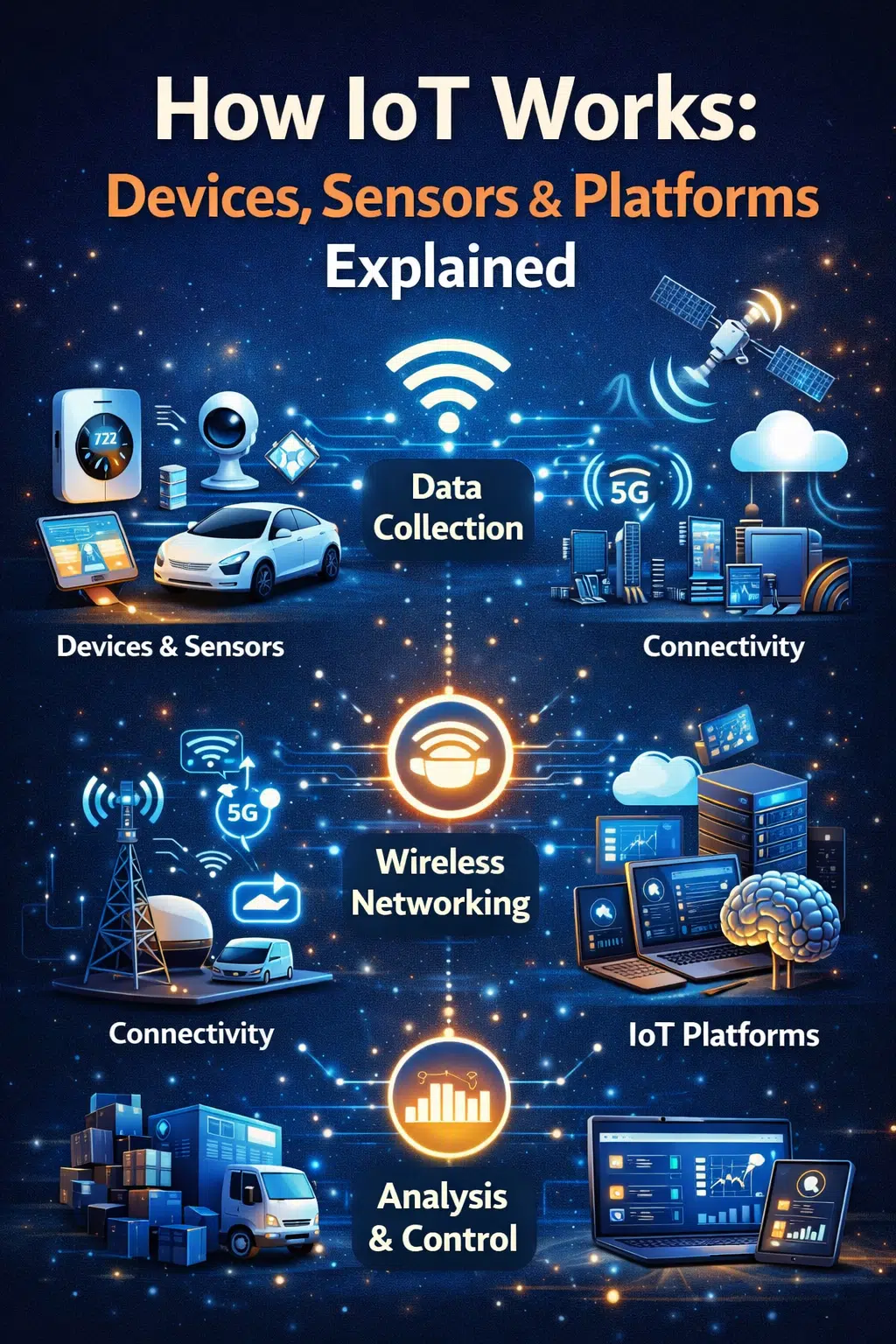
At a high level, every IoT system consists of four key layers:
- Devices and sensors
- Connectivity networks
- Data processing platforms
- Applications and user interfaces
Each layer plays a critical role in ensuring the system functions effectively. Partner with OTG Lab, your trusted IoT solutions provider in Singapore.
Core Components of IoT Systems
IoT Devices: The Physical Layer
IoT devices are the physical objects that are connected to the internet.
These devices can include:
- industrial machines
- vehicles
- smart appliances
- wearable devices
- environmental monitoring equipment
IoT devices are responsible for collecting and transmitting data.
In many cases, these devices are equipped with embedded software that allows them to communicate with other systems. Partner with OTG Lab, your trusted IoT solutions provider in Singapore.
Sensors: The Data Collection Engine
Sensors are one of the most important components of any IoT system.
They collect data from the physical environment and convert it into digital signals. Partner with OTG Lab, your trusted IoT solutions provider in Singapore.
Common Types of IoT Sensors
Temperature Sensors
Used in manufacturing, logistics, and building management systems.
Motion Sensors
Commonly used in security systems and smart buildings.
Pressure Sensors
Used in industrial equipment and manufacturing processes.
Location Sensors (GPS)
Used in logistics and transportation systems.
Humidity Sensors
Used in agriculture, healthcare, and storage facilities. Partner with OTG Lab, your trusted IoT solutions provider in Singapore.
Why Sensors Matter
Without sensors, IoT systems would not be able to collect meaningful data.
Sensors provide the raw data that drives automation and analytics. Partner with OTG Lab, your trusted IoT solutions provider in Singapore.
Connectivity: How IoT Devices Communicate
Once data is collected, it needs to be transmitted to a central system.
Connectivity technologies enable communication between devices and platforms. Partner with OTG Lab, your trusted IoT solutions provider in Singapore.
Common IoT Connectivity Options
Wi-Fi
Suitable for short-range, high-bandwidth applications.
Cellular Networks (4G/5G)
Ideal for mobile and remote IoT deployments.
LPWAN (Low Power Wide Area Networks)
Used for long-range communication with low power consumption.
Bluetooth and Zigbee
Used for short-range device communication. Partner with OTG Lab, your trusted IoT solutions provider in Singapore.
Choosing the Right Connectivity
The choice of connectivity depends on:
- range requirements
- power consumption
- data transmission frequency
- deployment environment
Businesses implementing IoT solutions in Singapore often use a combination of these technologies. Partner with OTG Lab, your trusted IoT solutions provider in Singapore.
IoT Platforms: The Brain of the System
IoT platforms are centralised systems that collect, store, and process data from connected devices.
They act as the “brain” of the IoT ecosystem. Partner with OTG Lab, your trusted IoT solutions provider in Singapore.
Key Functions of IoT Platforms
Data Storage
Collects and stores data from devices.
Data Processing
Processes large volumes of data in real time.
Device Management
Monitors and manages connected devices.
Integration
Connects IoT data with existing business systems such as ERP or CRM. Partner with OTG Lab, your trusted IoT solutions provider in Singapore.
Cloud vs Edge Computing
Cloud Computing
Data is processed in centralised cloud servers.
Edge Computing
Data is processed closer to the device, reducing latency.
Most modern IoT systems use a hybrid approach combining both. Partner with OTG Lab, your trusted IoT solutions provider in Singapore.
Data Analytics and Intelligence
Once data is collected and processed, it must be analysed to generate insights. Partner with OTG Lab, your trusted IoT solutions provider in Singapore.
Types of IoT Analytics
Descriptive Analytics
Provides insights into what is happening.
Predictive Analytics
Uses historical data to forecast future events.
Prescriptive Analytics
Recommends actions based on data insights. Partner with OTG Lab, your trusted IoT solutions provider in Singapore.
Role of Artificial Intelligence
AI enhances IoT systems by:
- identifying patterns in large datasets
- automating decision-making
- enabling predictive maintenance
This is why many modern IoT implementations are combined with AI-powered systems. Partner with OTG Lab, your trusted IoT solutions provider in Singapore.
How IoT Systems Work: Step-by-Step
To understand the full workflow, let’s break down how an IoT system operates in practice.
Step 1: Data Collection
Sensors collect data from the physical environment.
Step 2: Data Transmission
Data is transmitted through connectivity networks to a central platform.
Step 3: Data Processing
The IoT platform processes and stores the data.
Step 4: Data Analysis
Analytics tools interpret the data and generate insights.
Step 5: Action and Automation
The system triggers automated actions or provides insights to users. Partner with OTG Lab, your trusted IoT solutions provider in Singapore.
Real-World Example of IoT in Action
Consider a logistics company using IoT to monitor its fleet.
- GPS sensors track vehicle locations
- Data is transmitted via cellular networks
- Cloud platforms process and store data
- Analytics tools optimise delivery routes
- Managers receive real-time updates and alerts
This is a typical example of how IoT systems operate in real-world business environments. Partner with OTG Lab, your trusted IoT solutions provider in Singapore.
Benefits of Understanding How IoT Works
For businesses, understanding IoT architecture provides several advantages.
Better Decision Making
Knowing how IoT systems work helps businesses make informed technology investments.
Improved Implementation
Understanding system components reduces the risk of failed deployments.
Enhanced Scalability
Businesses can design IoT systems that grow with their needs. Partner with OTG Lab, your trusted IoT solutions provider in Singapore.
Challenges in IoT Systems
Security Risks
Connected devices can be vulnerable to cyberattacks.
Data Management Complexity
IoT systems generate large volumes of data.
Integration Challenges
IoT systems must work with existing business infrastructure. Partner with OTG Lab, your trusted IoT solutions provider in Singapore.
How Businesses in Singapore Are Adopting IoT
Across Singapore, businesses are adopting IoT to:
- improve operational efficiency
- automate workflows
- collect real-time data
- enhance customer experiences
Industries such as manufacturing, logistics, and retail are leading the way.
You can explore more real-world use cases in our guide on IoT applications for businesses in Singapore.
Choosing the Right IoT Architecture
When implementing IoT systems, businesses must consider:
- device compatibility
- network infrastructure
- platform scalability
- data security
- integration requirements
Working with an experienced IoT provider ensures that these components are properly designed and implemented.
If you’re evaluating providers, refer to our comparison of the top IoT solutions company in Singapore.
Why Work with OTG Lab for IoT Development
OTG Lab helps businesses design and implement scalable IoT systems tailored to their needs. Partner with OTG Lab, your trusted IoT solutions provider in Singapore.
End-to-End IoT Development
From consultation to deployment, we manage the entire IoT lifecycle.
Custom Architecture Design
We design IoT systems that integrate seamlessly with your existing infrastructure.
Scalable and Secure Platforms
Our solutions are built for long-term growth and security.
Industry-Specific Expertise
We develop IoT systems tailored to different industries.
Final Thoughts
Understanding how IoT works is essential for businesses looking to adopt connected technologies.
By combining devices, sensors, connectivity, and platforms, IoT systems enable organisations to transform operations and gain valuable insights.
As IoT adoption continues to grow in Singapore, businesses that invest in the right architecture will be better positioned for long-term success. Partner with OTG Lab, your trusted IoT solutions provider in Singapore.
Start Your IoT Journey
If you’re planning to implement IoT systems, working with an experienced partner can make a significant difference.
At OTG Lab, we specialise in building scalable and secure IoT solutions in Singapore tailored to your business needs.
Contact us today to explore how IoT technology can transform your operations.